How do I create a custom format for Product Database records?
Accessing the "Product Custom Fields" Editor:

Creating Organizational Tabs and Data Entry Fields:
Creating Organizational Tabs:
Creating Data Entry Fields:
Saving Your Configuration:
Summary: New AI-powered translation feature allows automatic content translation when copying product database records into different languages. This tool streamlines the creation of multilingual product information.
New Feature: AI-Powered Content Translation in Product Database
Key Points:
Location: Media section of product database records
Function: Translate content into different languages while copying records
Languages: Multiple language options available (e.g., English to Dutch)
How to Use:
Start copying a database record
Select the desired target language
Check the "Translate content using AI" checkbox
The system will automatically translate the record's content

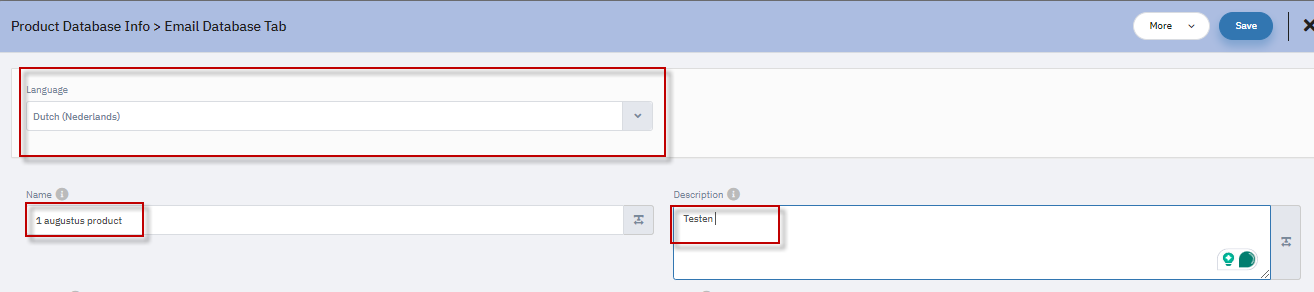
Important Note:
If the "Translate content using AI" checkbox is not selected, only the language field will change. The content will remain in the original language.

Quickly create multilingual product records
Save time on manual translations
Ensure consistency across language versions

A new enhancement has been introduced to the product database that provides additional options for displaying custom fields in the
records grid. This gives administrators greater control over how product information is presented and organized on the records page.
When creating or editing a product database field, two new options are now available in the Select a Grid Display dropdown.
Available Grid Display Options
The following options have been added:
Display in Grid
Display in Grid with Sort
Display in Grid
When this option is selected, the custom field will be displayed as a column on the Product Database Records page.
Display in Grid with Sort
When this option is selected:
The custom field will be displayed as a column on the product database records page.
The field will also be available as a sorting option, allowing users to sort records based on the values in that field.

Checkbox
Image
Document

Provides flexible grid display options for custom product fields.
Enables sorting by custom field values for easier record management.
Improves data visibility by surfacing relevant fields directly in the records grid.
Allows administrators to tailor the records view to organizational needs.
Enhances the overall usability of the Product Database Records page.
The new grid display options for Product Database custom fields give administrators enhanced control over how product information is presented. With the ability to display fields as columns and enable sorting, organizations can create a more organized and functional records view. While certain field types such as checkbox, image, and document are not supported, the enhancement provides valuable flexibility for the majority of custom field configurations.
Product Database - Folder Name Localization
A new enhancement allows administrators to localize Product Database folder names based on the language preferences of users. Previously, folder names could only be configured in English. With this update, folder names can be translated and displayed in multiple supported languages.
Product Database folder names can be localized into multiple supported languages.
Localized names are applied through the Localization icon during folder setup.
The folder name shown to each user follows their preferred language setting.
How to Localize a Folder Name
Create a new Product Database folder.
Enter the default folder name.
Click the Localization icon next to the folder name.
Select the desired languages and provide the corresponding localized folder names.
Save the changes.
Localized Folder Display
The folder name displayed on the media side depends on the user's selected preferred language. For example:
The folder name has been localized into Chinese.
A Partner User has Chinese selected as their preferred language.
The Product Database folder is displayed using the Chinese localized name for that user.
Note: If a localization has not been configured for the user's selected language, the default folder name is displayed.
Provides multilingual support for Product Database folder names.
Improves accessibility for partner users working in their native language.
Falls back to the default folder name when no localization exists, avoiding blank or missing labels.
Allows localization to be configured at the point of folder creation.
Supports organizations operating across international partner networks.
Folder name localization extends multilingual support into the Product Database. Administrators can configure translated folder names during folder setup, and each user sees the name matching their preferred language, with a reliable fallback to the default name when no translation exists. This delivers a more accessible experience for partner users across international networks.